Robot Character Flat Icon: Humanoid and AI Design for Modern Web Interfaces
In the rapidly evolving landscape of digital design, visual shorthand has become essential for communicating complex technological concepts quickly. The robot character flat icon, particularly those featuring humanoid forms or depicting specific interactions like saving a user, serves as a critical bridge between abstract artificial intelligence concepts and user-friendly interfaces. As businesses integrate more AI-driven tools, engineering platforms, and cybernetics services into their offerings, the demand for clear, scalable, and aesthetically pleasing vector illustrations has surged. Understanding the nuances of these icons—specifically the humanoid and isolated sign variations—is vital for designers, product managers, and developers aiming to enhance user experience without cluttering the visual field.
Defining the Humanoid Robot Flat Icon Aesthetic
A robot character flat icon is not merely a simplified drawing; it is a strategic design element rooted in the principles of minimalism. The "flat" style removes three-dimensional effects such as gradients, shadows, and textures, focusing instead on clean lines, solid colors, and geometric shapes. When applied to a humanoid robot, this style strips away the uncanny valley often associated with realistic robotic depictions, resulting in an approachable, neutral, and modern symbol.
The distinctiveness of the humanoid variant lies in its ability to personify technology. Unlike abstract gears or circuit boards, a humanoid figure suggests agency, assistance, and interaction. This is particularly relevant in contexts involving customer support chatbots, AI assistants, or automated engineering solutions. The isolation of the sign—meaning the character is presented against a transparent or neutral background—allows for versatile integration across various web design elements, from navigation bars to hero sections.
The "Saving Woman" Motif: Symbolism in Cybernetics
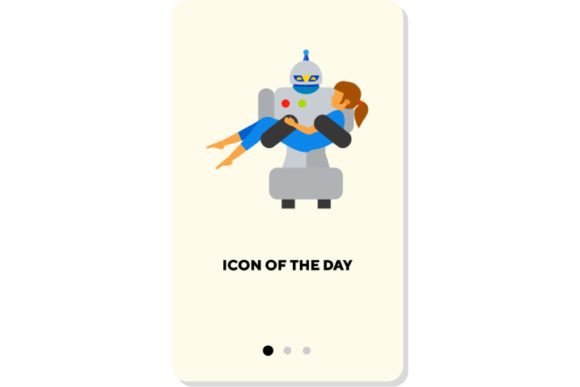
One specific subset of these icons involves dynamic interactions, such as a robot saving or assisting a human figure, often depicted as a woman in standard stock illustration libraries. This imagery transcends mere decoration; it communicates safety, reliability, and proactive support. In the realm of cybernetics and AI engineering, this visual metaphor reassures users that technology is designed to aid rather than replace or threaten. For websites offering security software, health-tech monitoring, or emergency response automation, this specific iconography can significantly influence user trust and perception of brand values.
Comparing Flat Icons with Other Design Styles
When evaluating visual assets for web design, professionals often weigh flat icons against other popular styles, including skeuomorphic, 3D, and line-art icons. Each approach offers distinct advantages and tradeoffs depending on the project’s goals.
- Flat vs. Skeuomorphic: Skeuomorphic designs mimic real-world textures and materials. While they can feel familiar, they often appear dated and heavy on modern, high-resolution screens. Flat icons, by contrast, load faster and scale infinitely without losing clarity, making them superior for responsive web design.
- Flat vs. 3D Illustrations: 3D robot characters have gained popularity for their depth and engagement. However, they require significantly more processing power to render and can distract from core content if overused. Flat icons provide a balanced alternative, offering recognizable forms without the visual weight or performance costs of 3D models.
- Flat vs. Line Art: Line art icons are minimalist and elegant but can sometimes lack the emotional resonance of filled shapes. A filled flat icon of a humanoid robot conveys more presence and authority, which is beneficial when highlighting key features like AI capabilities or engineering prowess.
The choice ultimately depends on the overall design language of the website. For tech-heavy platforms emphasizing precision and speed, the crispness of flat vector illustrations often aligns best with the brand identity.
Technical Advantages of Vector Illustrations
The underlying format of these icons—vector illustration—is as important as the visual style. Vector files (such as SVG, AI, or EPS) use mathematical equations to define shapes, unlike raster images (JPEG, PNG) which rely on pixels. This distinction is crucial for web design for several reasons:
- Scalability: A vector robot icon remains sharp at any size, from a tiny favicon to a large billboard graphic. This ensures consistency across devices with varying screen densities, including retina displays.
- File Size Efficiency: Vector files are typically smaller than high-quality raster images, contributing to faster page load times. Speed is a critical factor in SEO and user retention.
- Customizability: Designers can easily adjust colors, strokes, and proportions of vector elements without quality loss. This allows for seamless integration with a company’s existing color palette and branding guidelines.
For engineering and AI concepts, where precision is paramount, the clean edges of vector graphics reinforce the message of accuracy and technical competence.
Best-Fit Situations and Use Cases
Identifying when to deploy a robot character flat icon requires an understanding of user intent and context. These icons are most effective in scenarios where immediate recognition of technological assistance is needed.
Customer Support and Chat Interfaces
The most common application is in customer support widgets. A friendly humanoid robot icon signals to users that they are interacting with an automated system. This sets appropriate expectations regarding response time and capability. Using a "saving" or "helping" motif can soften the interaction, making the AI seem more supportive and less mechanical.
Engineering and SaaS Dashboards
In software-as-a-service (SaaS) platforms focused on engineering or data analysis, robot icons can represent automation features, bot-driven analytics, or system health checks. Here, the flat style complements the data-heavy interface by providing visual breaks without adding clutter. The isolated nature of the sign allows it to sit comfortably alongside charts and graphs.
Educational Content on AI and Cybernetics
For blogs, courses, or informational pages explaining artificial intelligence, these icons serve as visual anchors. They help break down complex topics into digestible segments. For instance, an icon of a robot analyzing data can accompany a section on machine learning algorithms, aiding cognitive processing for the reader.
Limitations and Decision Factors
While versatile, robot character flat icons are not a universal solution. Designers must consider potential limitations:
Lack of Emotional Depth: The simplicity of flat design can sometimes feel sterile or impersonal. If a brand aims to convey warmth, empathy, or high-touch human service, a overly robotic icon might create psychological distance. In such cases, combining the robot icon with warmer colors or pairing it with human-centric photography may be necessary.
Overuse and Cliché: The robot icon has become a ubiquitous symbol for AI. Without unique stylistic tweaks, it can fail to differentiate a brand from competitors. Customizing the humanoid features, posture, or accompanying elements (like the "saving woman" scenario) can help maintain distinctiveness.
Cultural Interpretations: Symbols are interpreted differently across cultures. While a humanoid robot is generally understood in tech-savvy demographics, ensuring the icon’s gesture (such as helping or saving) is universally positive is essential for global audiences.
Making the Right Choice for Your Project
Selecting the appropriate visual asset involves balancing aesthetic preferences with functional requirements. If your primary goal is clarity, speed, and modernity, a robot character flat icon is an excellent choice. It communicates the essence of artificial intelligence and engineering efficiently. However, if your project demands high emotional engagement or realistic depiction, you might explore 3D illustrations or custom photography.
Consider the specific narrative you wish to convey. If the focus is on protection and assistance, look for variations that depict interaction, such as the humanoid robot aiding a human figure. If the focus is on raw computational power, a more abstract, geometric robot head might be more appropriate. Always test the icon within the actual interface context to ensure it enhances rather than distracts from the user journey.
Ultimately, the value of these vector elements lies in their ability to simplify the complex. By choosing well-crafted, semantically relevant icons, designers can create intuitive, accessible, and visually cohesive digital experiences that resonate with today’s tech-oriented audience.